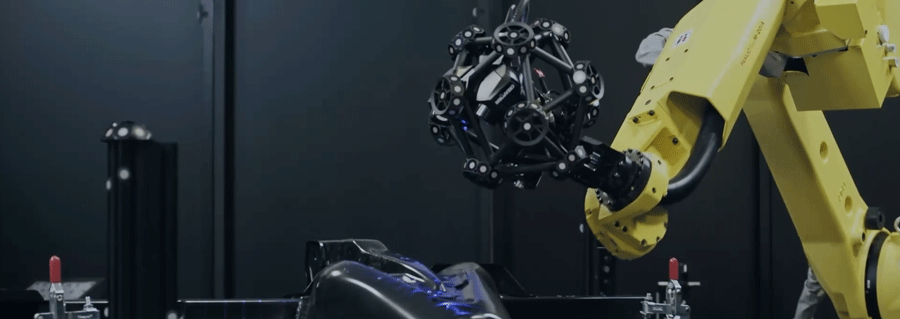
Designing customized integrated components for space-constrained aircraft typically presents a variety of unique challenges. Once installed, new elements must fit perfectly with surrounding structures and overhead panels. Even the most minute dimensional deviation can impact both the functional performance and aesthetic appearance of the entire assembly.
How to integrate custom-designed components into extremely space-constrained environments?
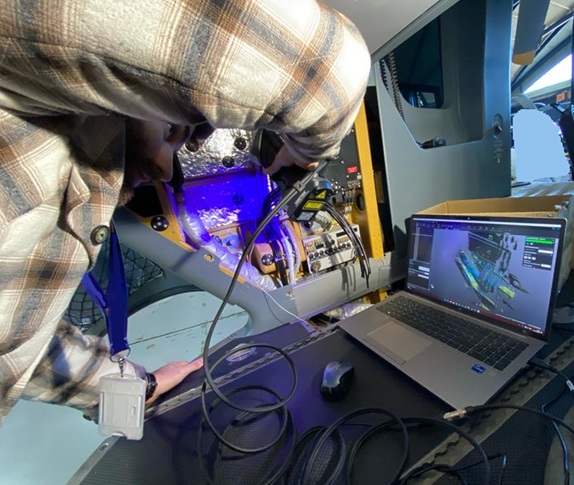
To design new components that fit perfectly, it is crucial to accurately capture the geometric data of the installation environment (including surrounding surface morphology and wiring areas) and generate a high-precision CAD model as a design baseline. This approach not only ensures that new components meet strict tolerance requirements but also guarantees a seamless fit after installation.
What are the limitations of traditional measurement tools and manual data acquisition?
Fundamentally, manual data acquisition is not only inefficient and prone to high error rates but also significantly lacking in accuracy and repeatability. In scenarios involving complex part structures and special surface features, traditional measurement tools or manual methods simply cannot reach the required precision standards.
What adverse consequences must aerospace companies avoid when designing customized components?
If certain critical tolerances cannot be effectively verified, the quality and functionality of core components may be compromised. In the aerospace sector, comparing part measurement data with CAD models or technical specifications is essential to ensure product compliance with tolerance requirements.
Furthermore, companies must demonstrate component compliance through detailed technical reports and achieve full traceability of measurement data throughout the product lifecycle, further highlighting the importance of adopting higher-precision measurement solutions.
High Precision
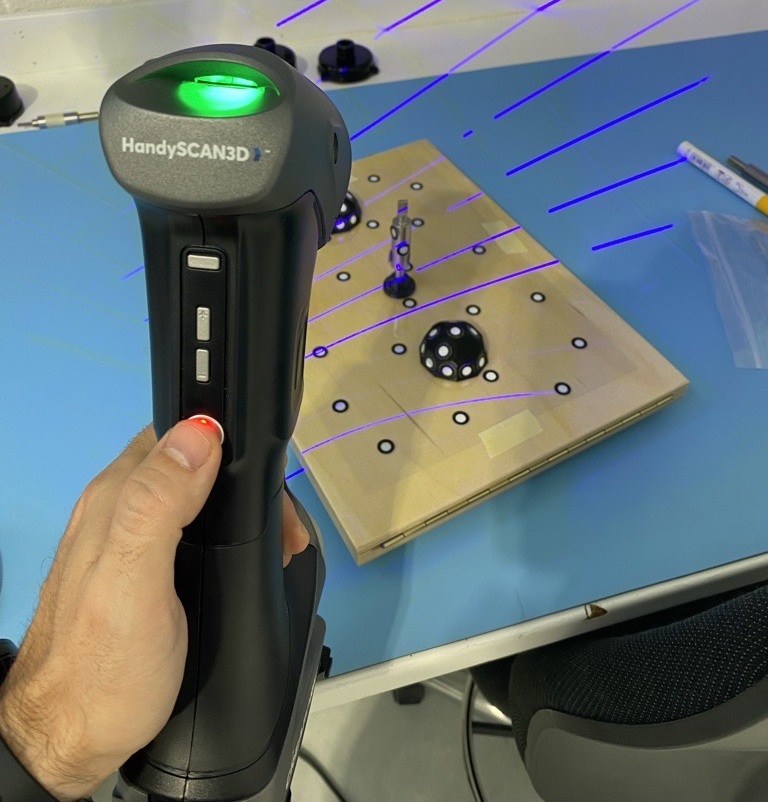
To meet the stringent requirements of the aerospace industry, the solution must be capable of high-precision, high-repeatability 3D measurements of precise geometries and complex surfaces. Professional-grade 3D scanners meet these accuracy requirements while maintaining stability, unaffected by environmental measurement conditions or the user's experience level.
Portability
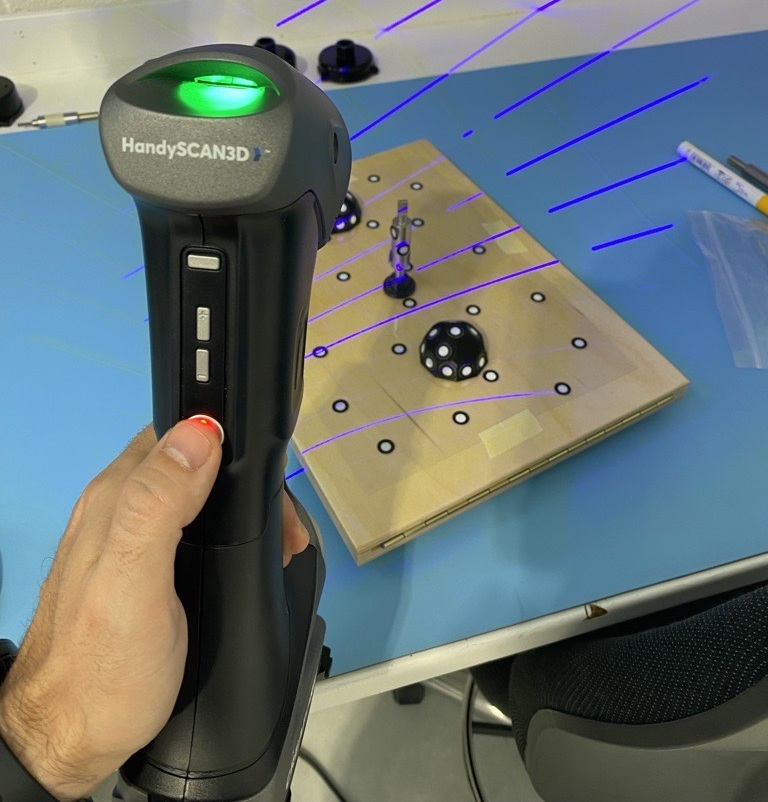
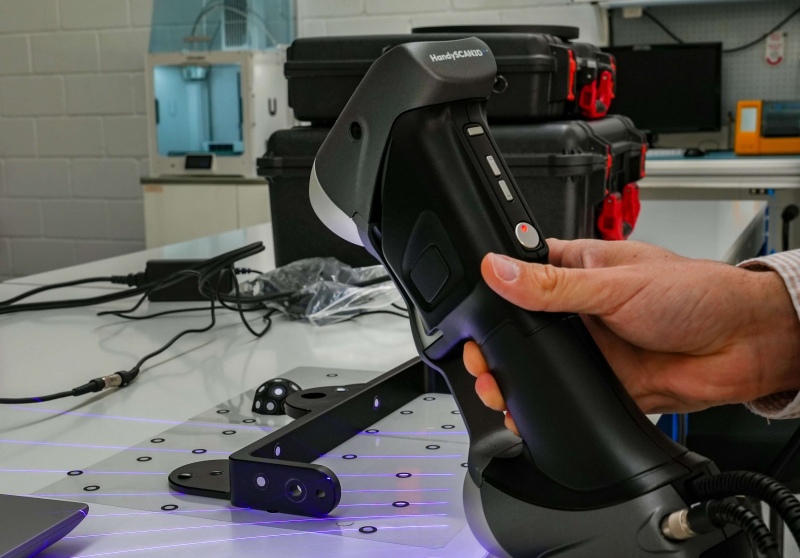
Handheld 3D scanners utilize the principle of optical reflective target triangulation to independently determine their position relative to the part being measured. Functioning as completely self-contained devices without the need for tripods or external tracking systems, their compact size allows them to fit into small carrying cases for easy transport to any site, maintaining high-precision measurements even in harsh environments.
Ease of Use
Thanks to an intuitive and easy-to-operate software interface, the solution significantly reduces operator training time. Technicians can become productive immediately upon acquisition, with further training allowing them to gradually unlock the full range of the device's capabilities.
The software features both 2D sketching and 3D modeling capabilities, enabling design engineers to sketch and build models directly from scan data. Additionally, models can be parametrically transferred to SOLIDWORKS, facilitating design modifications and feature-based modeling. Supporting the import of editable, real CAD models effectively streamlines the design process.
When paired with the Scan-to-CAD reverse engineering software module within the Creaform Metrology Suite, the 3D scanner stands as the benchmark for 3D scanning solutions that integrate high precision, portability, and ease of use.
Enhancing Quality Control and Design Capabilities to Create Higher Quality Components
By incorporating 3D scanners into their metrology toolkit, aerospace companies not only optimize their quality control processes but also enhance their design and R&D capabilities. The new solution reduces errors and accelerates the design process, ultimately resulting in the creation of higher-quality aerospace components.
A Timely and Economical Investment with High Return
Professional-grade 3D scanners satisfy the dual requirements of aerospace companies for both model design and dimensional control. Owning a versatile device is a highly cost-effective investment choice. Users only need to master one system to proficiently handle multiple application scenarios, which simplifies the training process and maximizes the return on investment (ROI) for the equipment.
Minimizing Errors
3D scanning completely eliminates manual data collection methods. It enables high-precision measurement of complex geometries and hard-to-measure surfaces. The scanned dimensional data provides a reliable basis for engineers to design new components, giving them the confidence that every part will fit perfectly within tight spaces, achieving a precision standard with near-zero error.
Improving Component Quality
3D scanners help aerospace companies accurately verify critical tolerances, preventing errors from affecting the quality and functionality of core components. It allows for easy comparison of measured data against CAD models or technical specifications, ensuring that every component meets the required tolerance specifications.
Europavia has been active in the aviation sector for over 60 years, providing components, equipment, and maintenance services to military and national security agencies, with a focus on ensuring the stable operation of various systems throughout their entire lifecycle.
The company's core business includes MRO logistics management, aviation equipment maintenance, and the promotion and distribution of advanced technologies and systems within the Spanish aviation, defense, aerospace, and infrastructure markets.
Through close collaboration with leading international manufacturers, Europavia provides cutting-edge technical products to the national aerospace and defense industries. Leveraging its EASA (European Union Aviation Safety Agency) certified maintenance center, the company has further expanded its business scope by adding engineering and manufacturing services, dedicated to providing customers with integrated solutions.
Europavia has applied the HandySCAN 3D portable 3D scanner to the design, engineering, and maintenance processes of its aviation platforms.
Tel: +86 13621649661
email: info@thaiform.com