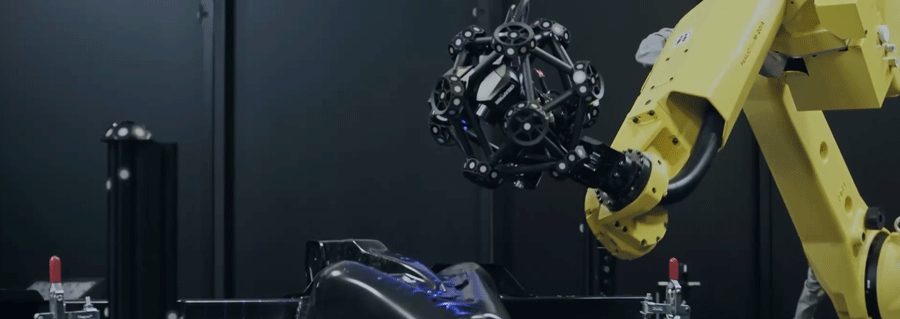
Foundries play a vital role in the automotive industry, especially aluminum foundries focused on producing core engine components and structural body parts. Components such as engine blocks, transmission housings, rear suspension arms, and subframes are essential for ensuring vehicle performance and reliability. Because these parts must withstand high-strength mechanical loads and operate under harsh conditions, no errors can occur during the production process. Every casting must meet the customer's strict specifications, and rigorous quality control must be executed at every production stage.
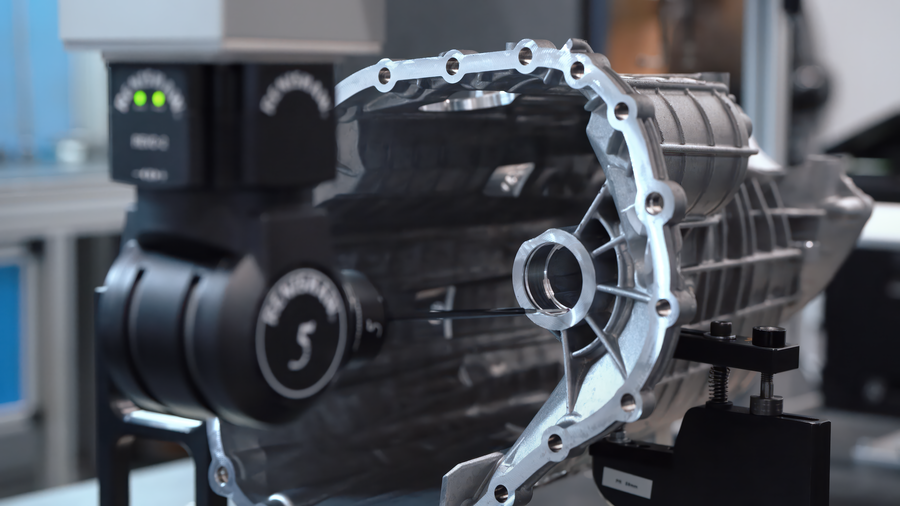
What are the risks of relying primarily on Coordinate Measuring Machines (CMM) for casting inspection?
If casting inspection relies mainly on CMMs, only a limited number of discrete points on the part can be measured. This only represents local information of the geometry, which may lead to surface deviations or the failure to detect hidden defects. Ultimately, significant defects may be missed, thereby affecting product quality and compliance with specifications.
How should the overall geometry of a casting be inspected to ensure it meets tolerance requirements?
Inspecting castings requires multi-dimensional measurements of components with complex geometries, especially in harsh inspection environments. Unlike traditional contact probing methods, 3D scanning equipment can capture the geometric shape of the entire surface of a part, rather than just measuring discrete points. By analyzing the complete geometric data, 3D scanners can verify if the material distribution is sufficient to support subsequent machining, ensuring that parts consistently meet tolerance requirements.
How to shorten inspection time and accelerate the quality control process?
Complete geometric data of a casting can be obtained through a single 3D scan, enabling simultaneous multi-dimensional inspection and the acquisition of complete measurement data. This eliminates the time-consuming process of point-by-point measurement and significantly accelerates the speed of quality control.
Inspection software also facilitates the immediate comparison of the casting against the CAD model by operators. Deviations are clearly marked using color maps, which speeds up the decision-making process and reduces the workload of manual inspection. Early detection of dimensional errors prevents non-conforming castings from entering subsequent production stages, reducing rework, scrap, and unnecessary machining or assembly costs.
Furthermore, 3D scanning requires no pre-treatment of the part surface. Castings can be inspected directly on the production floor without the need to transport heavy and bulky castings to a metrology lab. This not only shortens handling time but also provides the production team with faster data feedback, further optimizing the quality control process.

*The operator uses the HandySCAN 3D, a metrology-grade blue laser 3D scanner from Creaform, to inspect large castings on the shop floor.
3D scanning provides foundries with a portable, high-precision, high-speed, and versatile solution to measure, inspect, and verify castings at every stage of production.
Portability
Handheld 3D scanners can be brought directly to the casting for on-site inspection on the shop floor, eliminating the need to transport parts to a CMM. This not only saves valuable time but also increases the volume of inspections and the overall efficiency of operators.
High Precision
Metrology-grade 3D scanners with ISO 17025 certification offer the precision required to measure complex cavities and detect even the slightest deviations from specifications. Utilizing dynamic referencing technology, these devices maintain accurate measurements even in complex workshop environments, remaining unaffected by vibrations, temperature fluctuations, or other common foundry conditions.
Speed
A 3D scanner can capture the complete geometry of a casting within minutes. Color maps help quality control personnel quickly compare the part against the CAD model, verifying dimensional deviations much faster than traditional measurement methods. This rapid assessment not only shortens inspection times but also enables a significant leap in production output.
Versatility
3D scanners can handle parts of various sizes, shapes, geometric structures, and levels of complexity. Castings with specialized surface materials or high contrast can be measured without the need for pre-treatment or surface coating, ensuring consistency in inspection results across all components.
Metrology-grade 3D scanners (such as the HandySCAN 3D) and inspection software (such as PolyWorks) are typical examples of portable, high-precision, high-speed, and versatile 3D scanning solutions.
Scene Description:
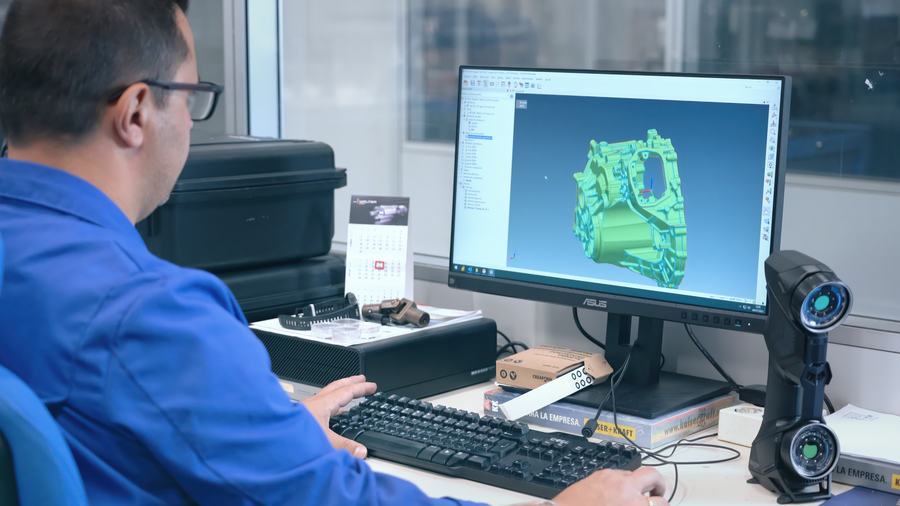
An engineer uses PolyWorks metrology software to analyze the 3D scan of an automotive casting on a computer; a HandySCAN 3D, a metrology-grade portable blue laser 3D scanner, is placed on the desk.

Shop-Floor Quality Inspection Without Pre-treatment
With 3D scanners, even the most complex geometries can be verified before the Part Submission Warrant (PSW) process begins, ensuring every casting meets the customer's exact specifications.
High-Resolution Scanning for Superior Quality Control
Foundries can now perform inspections directly on the production floor without compromising accuracy or requiring surface pre-treatment. Compared to CMMs, 3D scanners help quality control teams reduce time spent on training, part handling, and programming, allowing them to capture more comprehensive data for a higher volume of parts in less time.
Enhanced Part Quality
By conducting inspections at various production stages, teams can clearly identify issues such as material shortage in critical areas or deviations from the CAD model. This proactive control ensures that castings consistently align with customer specifications and meet strict tolerance requirements.
Significant Reduction in Inspection Time
3D scanning technology slashes inspection times from hours to minutes while maintaining an accuracy of 0.025 mm. This optimized workflow reduces the processing time for each casting by up to 30 minutes, ensuring precise defect identification. This boost in efficiency allows more parts to be produced and inspected in a shorter timeframe, effectively reducing delivery lead times for customers.
Rows of stacked automotive castings on the shop floor illustrate the massive volume of parts requiring inspection—a visual testament to how 3D scanning transforms the inspection timeline from hours into mere minutes.

Located in the industrial heart of Madrid, Martinrea Honsel Spain has been a cornerstone of the automotive industry for over sixty years. Founded in 1960, the company is a leading aluminum foundry producing engine, transmission, chassis, and structural components for both passenger and commercial vehicles. It also manufactures precision components for mechanical engineering and other specialized sectors.
Throughout its 60-year history, Martinrea Honsel has consistently balanced tradition with innovation, translating customer needs into advanced manufacturing processes and products. Their components are renowned not only for high strength but also for superior dimensional accuracy and exceptional surface quality.
To further elevate their standards, Martinrea Honsel Spain recently integrated Creaform’s metrology-grade portable 3D scanners to achieve precise full-part scanning. This new solution enables finer inspection, faster verification, and a higher standard of quality control.
Looking ahead, the company plans to expand the application of this technology to large-scale surface inspections—such as mold cavities and frames—aiming for even greater leaps in quality and operational efficiency.
Tel: +86 13621649661
E-mail: info@thaiform.com