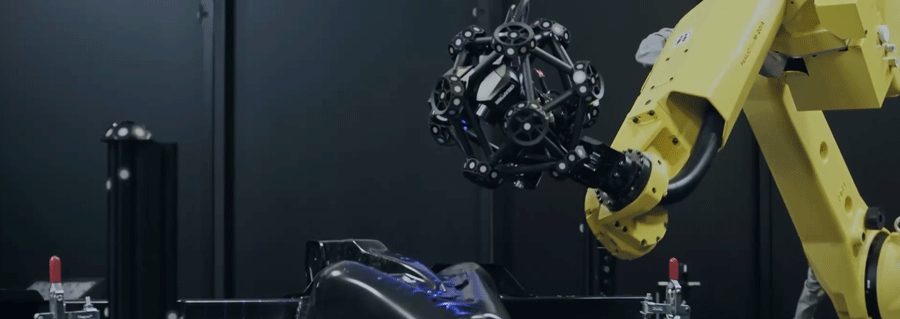
Automotive sheet metal parts must meet strict dimensional tolerances to ensure correct assembly. Even minor deviations can lead to assembly issues, such as misaligned components, gaps, or interference. Defects that go undetected in the early stages of production can disrupt the manufacturing process, delay production schedules, and increase scrap rates.
Quality control (QC) plays a critical role in detecting these deviations and ensuring parts comply with rigorous tolerances. However, few universal inspection solutions are capable of achieving precise measurements of sheet metal parts while remaining unaffected by environmental conditions and the user's level of expertise.
Why is CMM not the most effective inspection method for ensuring sheet metal quality?
Sheet metal parts often feature complex, irregular shapes with intricate curvatures and thin profiles. Measuring the entire geometry requires calibrating every probe orientation, which extends the inspection process and reduces efficiency. Additionally, areas such as edges, narrow corners, or undercuts may be inaccessible or difficult to measure, resulting in incomplete inspections.
While Coordinate Measuring Machines (CMMs) offer high precision, they are slow and require skilled operators for setup and operation. This limits measurability and decreases efficiency, creating bottlenecks in the manufacturing process and prolonging inspection times.
Why are inspection fixtures not the most economical solution for sheet metal part inspection?
Inspection fixtures are only suitable for specific components. Their lack of versatility means they cannot be reused for different designs or adjusted for frequent product changes. Due to wear and tear, these fixtures also require regular maintenance, increasing long-term costs, and their bulky size incurs significant storage costs. Furthermore, any modification to the sheet metal part renders the fixture obsolete, resulting in expenses for replacement.
Why is white light technology combined with gray cloud extraction not the most precise method for inspecting sheet metal quality?
Gray cloud extraction technology only performs optimally under specific, controlled lighting conditions. Any subtle changes in ambient light and background common on the shop floor can cause uneven light capture in white light technology. This interference affects the measurement of sheet metal parts, potentially impacting edge detection and measurement accuracy. Additionally, multiple parameters must be adjusted, making accuracy entirely dependent on the user's ability to handle these complexities.
Why do quality control professionals in the automotive industry trust CMM results more than 3D scan data?
It is often easier to question the reliability of data and equipment than to address potential manufacturing defects, especially for complex sheet metal parts requiring accurate data acquisition and comprehensive analysis. Therefore, quality departments must eliminate uncertainty and variation caused by equipment or measurement methods.
These measurement variations may result from the acquisition stage (environmental sensitivity and acquisition parameter settings) or from extraction parameters that vary by sheet metal model. Consequently, a solution is needed that is insensitive to environmental changes, provides appropriate guidance during acquisition, and eliminates the need for extraction parameters.
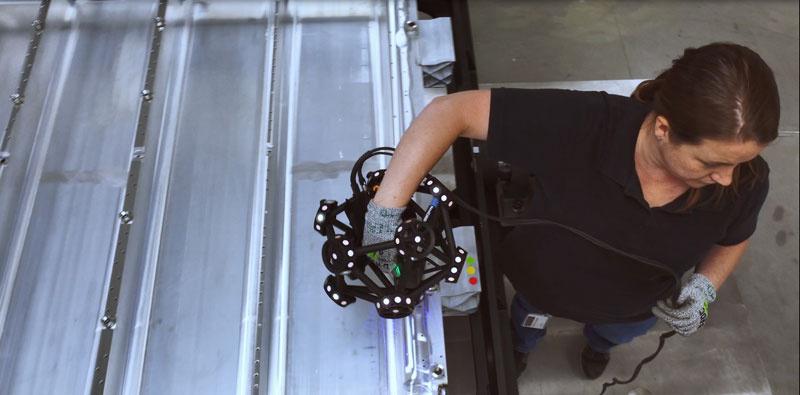
Compared to a CMM, a 3D scanner captures comprehensive data in a single scan, delivering sheet metal inspection results faster. When integrated with advanced software, 3D scan data can be processed rapidly—achieving a Best Fit with the CAD model in just three clicks—ensuring reports are generated at maximum speed.
In contrast to inspection fixtures, laser scanning systems are highly versatile, measuring various part shapes and sizes without the need for custom tooling. A single 3D scanning device can adapt to different geometric features, making design changes and adjustments for automotive components more convenient.
Ease of Use
When data acquisition is performed through an intuitive interface that provides visual indicators of the areas to be inspected, it ensures sufficient data collection for reliable quality control. Guided data acquisition removes dependency on the operator, eliminating the need for highly specialized skills.
Accuracy
The key to precision lies in minimizing human-induced measurement variations. Laser 3D scanners are less affected by environmental factors, requiring fewer parameter adjustments during acquisition. This simplifies the measurement process, making it more reliable and accurate.
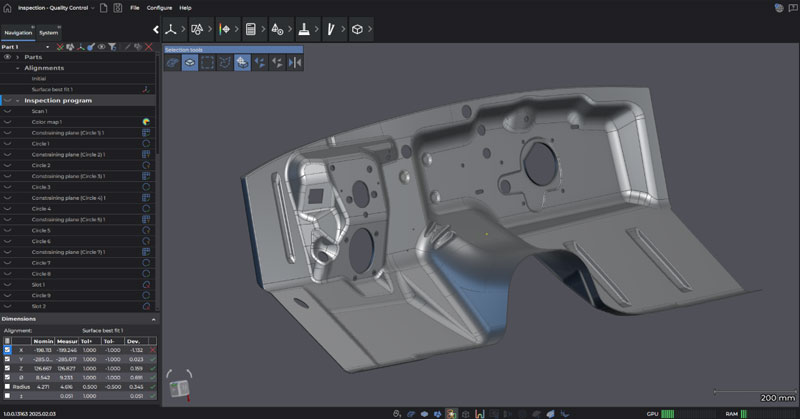
As an integral part of the Metrology Suite™, the inspection software module's new sheet metal plugin provides highly repeatable and precise 3D measurements. This effectively boosts the confidence of quality control professionals in their scan data.
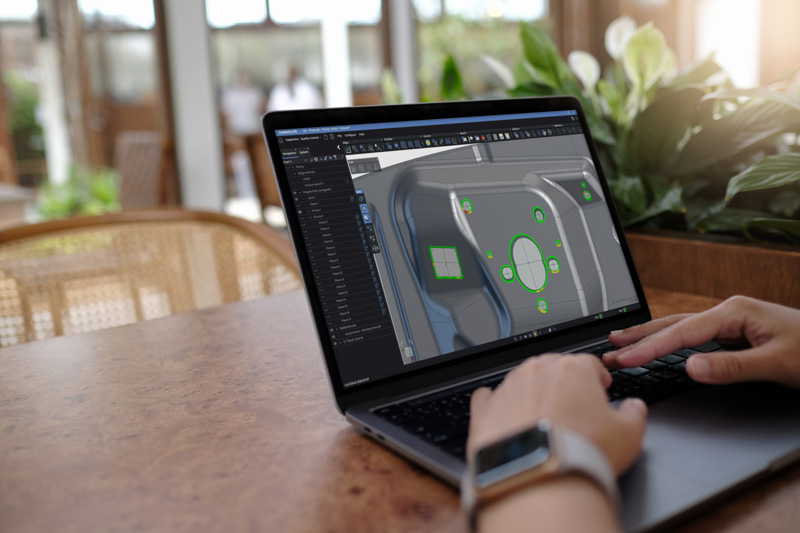
The Sheet Metal Plugin enables automotive manufacturers to have complete confidence in their inspection reports.
Featuring a simple and intuitive interface, the plugin visually displays the sheet metal areas that require inspection, guiding operators through the data acquisition process. This ensures that sufficient data is collected to achieve highly efficient quality control.
High Confidence in Inspection Results
By integrating the inspection software module with the acquisition platform Creaform.OS™, visual guidance and feedback are provided throughout the entire inspection process. This ensures that quality control experts can access acquisition parameters at any time when evaluating whether geometric features meet tolerance requirements, eliminating doubts regarding data reliability. Consequently, they can clearly determine whether deviations stem from manufacturing defects or other factors such as material variations, environmental impacts, or tooling issues.
Optimized Decision-Making and Refined Manufacturing Processes
Obtaining reliable data through fast, accurate 3D scanners and the sheet metal plugin streamlines the inspection process. Quality control experts gain comprehensive insights—through environmental and heat treatment checks, tooling and fixture audits, or design and tolerance reviews—allowing them to optimize tool maintenance schedules and refine manufacturing processes.
A Cost-Effective Solution for Diverse Sheet Metal Measurement Needs
Laser scanning systems offer a highly economical method for measuring a wide variety of sheet metal parts without the need for custom fixtures or the associated storage and maintenance costs. A single 3D scanner can flexibly adapt to different sizes, shapes, and geometric features, making design changes and adjustments for automotive sheet metal components seamless and cost-effective.
Tel: +86 13621649661
E-mail: info@thaiform.com